

 Chris Edwards
TL;DR: Most U.S. citizens don’t legally need a passport for a Caribbean or Bahamas cruise, as long as it’s a round-trip sailing from the same U.S. port. You can board with a government-issued photo ID and a certified birth certificate instead. But passports are always the smarter choice. If a medical emergency forces you to fly home, a birth certificate won’t get you on that plane. This guide covers every scenario so you know exactly what to bring.
You found a great cruise deal. The ship looks amazing, the itinerary hits all the right islands, and the price fits your budget. Then it hits you: your passport expired six months ago. Or maybe you never got one. Now you’re wondering if the trip is even possible.
Here’s the good news. Depending on your itinerary, you may not need a passport to go on a cruise at all. U.S. citizens have more flexibility than most people realize. But there’s real fine print involved, and getting it wrong could mean getting turned away at the port. This guide breaks down exactly when a passport is required, when it isn’t, and why most cruise experts will still tell you to get one anyway.
Do You Need a Passport to Go on a Cruise? (The Short Answer)
No, U.S. citizens are not always required to have a passport to board a cruise ship. On round-trip cruises that depart and return to the same U.S. port and visit destinations in the Caribbean, Bahamas, Mexico, Canada, or Bermuda, you can legally sail with a certified birth certificate and a government-issued photo ID. A passport is strongly recommended but not always mandatory.
This rule comes from the Western Hemisphere Travel Initiative (WHTI), which governs what documents U.S. citizens need to re-enter the country by sea. The key phrase is “re-enter by sea.” The WHTI gives U.S. citizens on qualifying cruises a bit more flexibility than you’d have if you were flying internationally.
That said, the U.S. Department of State strongly recommends that all cruise passengers travel with a passport book, even when it’s not technically required. We’ll get into why that matters in a minute.
What Is a Closed-Loop Cruise?
A closed-loop cruise is a round-trip sailing that departs from and returns to the same U.S. port, with at least one stop at a foreign destination in between. That “same port, same country” detail is the key to the no-passport rule for U.S. citizens.
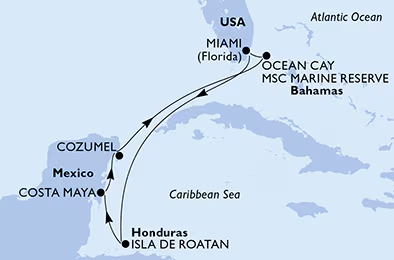
Here’s a simple example. A 7-night Western Caribbean sailing that leaves Miami on a Monday and returns to Miami the following Monday? That’s a closed-loop cruise. A 3-night Bahamas getaway on Utopia of the Seas that departs from Port Canaveral and stops at Perfect Day at CocoCay before heading home? Also closed-loop.
The same applies to many popular Florida itineraries. Royal Caribbean’s round-trip sailings from Miami on Icon of the Seas, for instance, qualify as closed-loop cruises. So do most Carnival, Norwegian, Disney, and Celebrity sailings that start and end in Florida ports.
What Is NOT a Closed-Loop Cruise?
If your cruise starts in one U.S. port and ends in a different one, it’s not closed-loop. Repositioning cruises fall into this category. So do Panama Canal sailings that cross from the Atlantic to the Pacific side. A cruise that departs from Fort Lauderdale and ends in Los Angeles would require a passport, even though both ports are in the United States.
Any cruise that starts or ends outside the U.S. is also not closed-loop. A round-trip Mediterranean sailing from Barcelona, for example, does not qualify, even if it’s technically a round trip from the same city.
What Documents Do You Need If You Don’t Have a Passport?
If you’re sailing on a closed-loop cruise without a passport, U.S. citizens need two documents: a government-issued photo ID and original proof of citizenship. Both are required. One alone is not enough.

Here’s what counts as valid proof of citizenship on a closed-loop cruise, according to U.S. Customs and Border Protection:
Acceptable Proof of Citizenship
- Certified birth certificate issued by a state Vital Records office, with a raised seal. This must be an original or a certified copy, not a photocopy. Hospital-issued birth certificates are not accepted. Neither are baptismal records or voter registration cards.
- U.S. Passport Card (more on this below)
- Enhanced Driver’s License (EDL), which serves as both proof of identity and citizenship. EDLs are currently only available in five states: Michigan, Minnesota, New York, Vermont, and Washington.
- Certificate of Naturalization
For the photo ID requirement, a standard driver’s license works. Your name must match across all documents. If you’ve had a name change, bring supporting documents like a marriage certificate or court order.
Rules for Kids Under 16
Children under 16 have slightly more flexibility. On closed-loop cruises, kids can sail with just a certified birth certificate, no photo ID required. That said, getting a passport for your child is still a smart move for the same emergency reasons that apply to adults.
Before you pack, make sure your travel documents are on your cruise packing checklist. It’s easy to double-check the fun stuff and forget the most important item in your bag.
When Do You Definitely Need a Passport?
Some cruises require a valid passport book, no exceptions. Here’s where the birth certificate and driver’s license combination stops working.
European, Mediterranean, Asian, and Australian Cruises
All cruises that depart from or arrive at ports outside North America and the Caribbean require a valid passport. European cruises require a passport for every passenger, and most countries also require that your passport be valid for at least six months beyond your return date. Check that expiration date carefully.
One-Way and Repositioning Sailings
One-way sailings from U.S. ports always require a passport, even if both ports are in the United States. This includes Panama Canal cruises and transatlantic repositioning voyages. A passport book is the only accepted document for these itineraries on most major cruise lines.
Cruises That Visit Certain Caribbean Islands
Even on an otherwise closed-loop Caribbean itinerary, a few specific destinations trigger a passport requirement. Carnival, Celebrity, Disney, Holland America, Princess, and Royal Caribbean all require a valid passport if your itinerary includes any of the French West Indies islands: Martinique, Guadeloupe, Saint Martin, or Saint Barts. Same goes for cruises that visit Colombian or Panamanian ports.
If you’re comparing cruise lines and want to understand how itinerary differences stack up overall, our Royal Caribbean vs. Norwegian breakdown covers a lot of ground that passport-aware cruisers will find useful.
Luxury Lines with Their Own Rules
Some cruise lines require a valid passport for every sailing, regardless of itinerary or departure port. Those lines include Azamara, Cunard, Hurtigruten, Oceania, Regent Seven Seas, Seabourn, SeaDream, Silversea, Star Clippers, and Windstar. Always check your specific cruise line’s travel document page before you assume the closed-loop exemption applies.
Flying to Your Departure Port Internationally
If you’re flying internationally to board your cruise, you need a passport for the flight. Period. A birth certificate won’t get you through airport customs. This applies even if the cruise itself would otherwise qualify as closed-loop.
Passport Book vs. Passport Card: Which One Is Right for Your Cruise?

The passport book covers all international travel by air, land, and sea, anywhere in the world. The passport card is a wallet-sized alternative that only works for land and sea crossings to Canada, Mexico, Bermuda, and Caribbean nations. It cannot be used for international air travel under any circumstances.
For most cruisers, the passport book is the better investment. It’s the only document that lets you fly home from a foreign country in an emergency. The passport card simply can’t do that.
Cost Comparison
Here’s how the pricing breaks down, according to the U.S. State Department:
- Passport book: Around $165 for first-time adult applicants (includes a $35 acceptance fee)
- Passport card: Around $65 for first-time adult applicants (includes the same $35 acceptance fee). Renewals drop to $30.
- Both together: You can apply for both at the same time on one application, which saves on the acceptance fee.
Processing Times
Routine processing currently takes 4 to 6 weeks. Expedited service brings that down to 2 to 3 weeks and costs an additional $60. If you need one faster, you can make an appointment at a regional passport agency with proof of travel within 14 days.
The passport card makes sense if you only ever take closed-loop Caribbean or Bahamas cruises and you’re absolutely sure you’ll never need to fly internationally in an emergency. For everyone else, the book is worth the extra cost.
The Real Reason You Should Just Get a Passport
Even when a passport isn’t required, cruise experts across the board recommend bringing one. The reason comes down to what can go wrong at sea.
Emergency Scenarios Where a Passport Becomes Critical
Think about these situations. You get seriously ill on a port day and need to be admitted to a local hospital. The ship sails without you. You’re stuck in a foreign country and need to fly home. Without a passport, getting on that international flight is nearly impossible.
Or maybe you miss the ship in port. It happens more than people think. Without a passport, rejoining the cruise or getting home on your own becomes a complicated, expensive mess.
The U.S. State Department is direct about this: a passport book is the only document that lets you fly home on an international flight in an emergency. A passport card won’t work. A birth certificate won’t work. Only the passport book covers that scenario.
The Cost Argument Doesn’t Hold Up
Some cruisers skip the passport to save the cost of the book. But think about what an emergency passport abroad actually costs. Emergency or expedited services at a regional agency, last-minute flights, potential hotel nights while you sort it out: the savings from skipping the passport disappear fast. For the price of a nice dinner out, the passport book buys you peace of mind for a decade.
Planning a cruise also comes with a lot of moving parts beyond documents. Understanding what’s really included in your cruise drink packages is one more thing worth sorting out before you board.
What to Know About Passport Validity
Even if you have a passport, it might not be valid enough. Most cruise destinations require your passport to be valid for at least six months beyond your return date. That means if your cruise returns to Florida on October 1, 2026, your passport needs to be valid through at least April 1, 2027.
Check that date before you book. Royal Caribbean’s policy, along with most other major lines, requires passports to be valid at least six months after the cruise ends. If it’s cutting it close, renew early.
Ready to Book Your Next Cruise?
Here’s the bottom line. Closed-loop Caribbean and Bahamas cruises from Florida ports give U.S. citizens the option to sail with a birth certificate and photo ID instead of a passport. That flexibility is real, and it’s backed by U.S. federal law. But it comes with serious limitations in any emergency situation.
Our honest recommendation: get the passport book. It covers every itinerary, every emergency, and every future trip you haven’t planned yet. The cost is small relative to the peace of mind.
Once your documents are sorted, the fun part begins. If you’re ready to find the right itinerary for your travel style and budget, request a free travel quote and we’ll help you find the perfect sailing, passport in hand.
Frequently Asked Questions
Can I go on a Caribbean cruise without a passport?
Yes, in many cases. U.S. citizens can sail on a closed-loop Caribbean cruise (one that departs from and returns to the same U.S. port) using a certified birth certificate and a government-issued photo ID instead of a passport. However, some Caribbean islands, including Martinique, Guadeloupe, Saint Martin, and Saint Barts, require a passport even on otherwise closed-loop itineraries. Always confirm your specific ports of call before you pack.
What documents do I need to cruise without a passport?
For a closed-loop cruise, U.S. Customs and Border Protection requires two things: a government-issued photo ID (like a driver’s license) for travelers 16 and older, and original proof of citizenship. Accepted citizenship documents include a certified birth certificate issued by a state Vital Records office with a raised seal, a U.S. Passport Card, an Enhanced Driver’s License (available in five states), or a Certificate of Naturalization. Hospital birth certificates and photocopies are not accepted.
Is a passport card good enough for a cruise?
It depends on your itinerary. A passport card works for closed-loop cruises that visit Canada, Mexico, the Caribbean, and Bermuda, but it cannot be used for international air travel. If a medical emergency or missed ship forces you to fly home from a foreign port, the passport card won’t get you on that plane. Only a passport book works in that situation. For most cruisers, the passport book is the smarter and safer choice.
Do kids need a passport to go on a cruise?
Children under 16 can sail on closed-loop cruises with just a certified birth certificate, no photo ID required. Children 16 and older follow the same rules as adults and need both a photo ID and proof of citizenship. That said, getting a passport for your child is still a good idea. If an emergency requires your child to fly home internationally, only a passport book makes that possible.
What happens if I need to fly home from a cruise without a passport?
If you only have a birth certificate or passport card, you’ll face serious complications. International flights require a passport book for U.S. citizens. Without one, getting home from a foreign port in an emergency means contacting the nearest U.S. embassy or consulate to apply for an emergency passport, which takes time and money and adds major stress to an already difficult situation. The U.S. State Department recommends all cruise passengers carry a passport book for exactly this reason.